Seattle's wealthiest families are quietly running the math on leaving. Their advisors should be running it with them.
By Jeff Reynolds · May 19, 2026

Jeff Reynolds, Seattle Condo Specialist. 20+ Years, 500+ Transactions, $500M+ Volume. Compass.
Over the last 18 months, three things have changed in Washington State that meaningfully alter the calculus for high-net-worth residents, business owners, and founders.
I want to lay them out together, because I keep meeting smart, successful people who know one piece but not the others. The integrated picture is what matters.
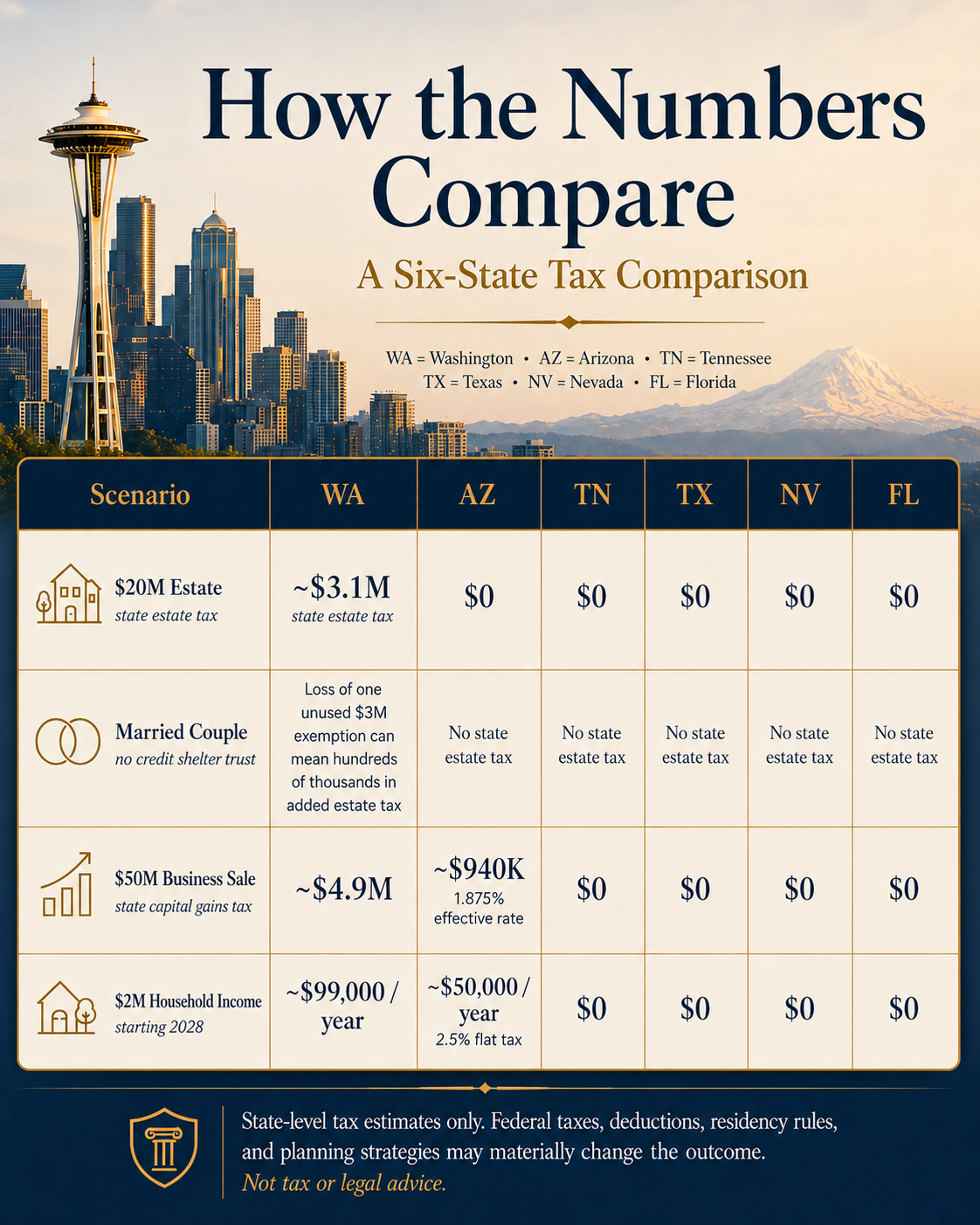
One. In 2025, the state estate tax top rate jumped from 20% to 35% for a 12-month window. On March 24, 2026, Governor Ferguson signed ESB 6347, rolling the top rate back to 20% for deaths on or after July 1, 2026. The exemption is $3,076,000 for the first half of 2026, then $3,000,000 starting July 1, 2026, with annual CPI adjustments scheduled to begin in 2027. Washington still does not allow spousal portability of the estate tax exemption, which means a married couple without proper trust planning can lose half of their combined shielding at the first death. On a $20M estate, the state estate tax is approximately $3.1M before federal tax even begins. In Tennessee, Arizona, Texas, Nevada, and Florida, the state estate tax is $0.

Two. Washington’s capital gains excise tax, upheld by the state Supreme Court in 2023, now charges 7% on long-term gains above approximately $278,000 and 9.9% on gains above $1M. Real estate and retirement accounts are exempt. Qualified family-owned small business gains may be deductible if statutory requirements are met. Most founder exits do not qualify. On a $50M company sale, the state component alone is approximately $4.9M. In Tennessee, Texas, Nevada, and Florida: $0. In Arizona: roughly $940K at the 1.875% effective long-term rate.
Five destinations. Four with zero state capital gains tax. One (Arizona) at less than a fifth of the WA bill. These are the states I am hearing about most often from Seattle condo owners in 2026, and the data tells you why.

Three. On March 30, 2026, the Governor signed SB 6346, Washington’s first-ever income tax targeting high earners. Beginning January 1, 2028, SB 6346 imposes a 9.9% tax on Washington taxable income for high-income taxpayers, with the policy aimed at households with adjusted gross income of $1M or more. First returns and payments begin in 2029. Constitutional and political challenges are widely expected. The state is leaning on the same “excise on the receipt of income” theory that upheld the capital gains tax in Quinn v. State. For planning purposes, high-income households should model both outcomes: the tax surviving and the tax being delayed, repealed, or invalidated.
None of these changes happened in a vacuum. They reflect a real and ongoing policy direction. They also reflect a real and ongoing decision by some of Washington’s most successful families to consider whether their next decade is best spent here or elsewhere.

I want to be precise: my job is not to push anyone to leave. My job is to make sure the math is in front of you.
Most real estate advisors I know are not having this conversation. They should be. For Seattle condo owners specifically, the math is even more layered. Your primary residence is one of the most tax-advantaged assets in your portfolio, and what you do with it (hold, sell, exchange, gift, transfer to trust) is rarely independent of the decision to stay or go. Residency planning happens months before a transaction, not days. The clients who get this right start the conversation 12 to 24 months in advance. The clients who get it wrong learn what aggressive state revenue audits feel like.

Over the past year, I’ve assembled a board of advisors specifically for these conversations: estate attorneys who actually practice in Washington, CPAs who specialize in multi-state residency transitions, wealth strategists who understand both pre-sale and post-sale architecture, and insurance specialists who can structure ILITs and other tools that move wealth out of the taxable estate.
If you want to stay in Seattle and pay less in tax, there are real, legal, court-tested strategies and I can introduce you to the people who execute them.
If you decide to leave, my job is to sell your Washington condo for the highest possible number and protect what you’ve built so the next generation actually receives it.
Either way, the math deserves to be on the table.
If you’re inside 24 months of a major liquidity event or estate transition and you do not currently have a quarterback for the cross-functional conversation, message me. Happy to introduce you to the right people on my board for your specific situation.
Jeff Reynolds, Seattle and Eastside Real Estate Advisor, Compass. UrbanCondoSpaces.com | SeattleCondoAuthority.com | TheEastsideEstates.com
(Nothing in this post is tax, legal, or financial advice. It is observation and connection. Talk to a licensed CPA and an estate attorney before making any decision.)
Search Condos
Find Your Seattle Condo
Search active listings across Seattle, Bellevue, and Kirkland. Personalized results delivered to your inbox.
Weekly Newsletter
Seattle Condo Market Briefing
Weekly insights on Seattle's condo market. Building updates, price trends, and neighborhood intel from 20+ years on the ground.
No spam. Unsubscribe anytime.
On Instagram
@jeffreynoldsseattle

Jeff Reynolds
Seattle Condo Specialist · Compass Real Estate
Jeff has spent 20+ years helping buyers and sellers navigate Seattle's condo market building by building. Have a question about this topic?